
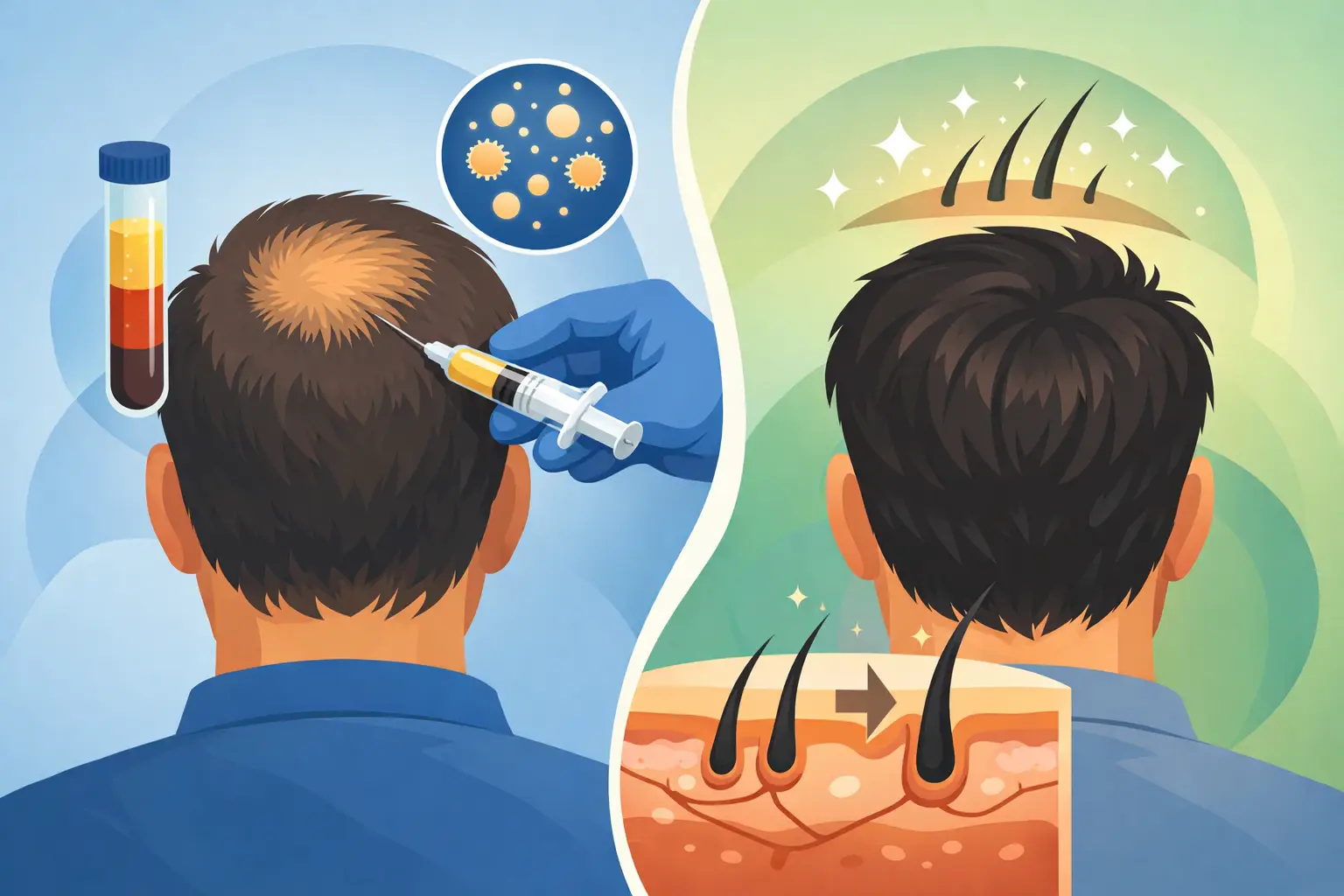
PRP (platelet-rich plasma) is a non-surgical treatment used for certain types of hair thinning. Research suggests that PRP may help support hair growth and improve hair density in some suitable patients, although individual results vary. The outcome can depend on the type and stage of hair loss, follicle activity and the treatment plan recommended following assessment.
Does PRP treatment regrow hair or just slow hair loss?
PRP stands for platelet-rich plasma. The treatment uses a small sample of your own blood, which is processed to concentrate the platelets. That plasma is then injected into targeted areas of the scalp where hair is thinning.
The reason PRP has become so popular is simple. Platelets contain growth factors that may help improve blood supply around the follicle, support tissue repair, and encourage inactive or weakened follicles to perform better. In practical terms, that can mean less shedding, thicker strands, and visible improvement in areas that still have living follicles.
So, does PRP treatment regrow hair? In many patients, it can help regrow hair that has thinned or become weaker over time. It is often more accurate to say PRP can improve growth in struggling follicles rather than bring back hair from completely bald, inactive skin. If a follicle is still alive, PRP may help it produce stronger hair. If the follicle is gone, PRP is unlikely to rebuild it.
That distinction matters. Patients with early to moderate thinning usually see the best response. Patients with advanced baldness may still benefit in some areas, but they often need to consider whether PRP should be combined with other hair restoration options.
How PRP works on thinning hair
Hair loss rarely happens overnight. Most people notice a gradual change first – finer hair, slower growth, more scalp visibility, and reduced density around the temples, crown, or part line. PRP is designed to target that stage, when follicles are underperforming rather than permanently lost.
Once injected into the scalp, the platelet-rich plasma works as a regenerative treatment. The goal is to create a healthier environment around the hair follicle. That can support stronger growth cycles and help produce hair that looks fuller and healthier.
Patients often ask whether the treatment is natural. Because PRP is created from your own blood, it is considered a biocompatible treatment with no synthetic filler or foreign implant involved. That appeals to many people who want a clinically led option that feels less invasive than surgery.
Who is most likely to see hair regrowth with PRP?
PRP is not a one-size-fits-all answer, but it can be an excellent choice for the right patient. The strongest candidates are usually men and women with early hair thinning, androgenetic hair loss, stress-related shedding, or reduced density after hormonal changes.
If you still have visible follicles and miniaturized hair in the treatment area, there is more for PRP to work with. Patients who act early often get the most noticeable cosmetic improvement because the follicles have not completely shut down.
PRP may also be used as part of a broader hair restoration plan. Some patients choose it to maintain density, some use it after a hair transplant to support healing and graft performance, and others want a non-surgical option before moving to anything more invasive.
At Essex Boys Medical Group, this is where consultation matters. Hair loss can look similar on the surface, but the cause, stage, and long-term outlook are not always the same. A professional assessment helps determine whether PRP is likely to be effective on its own or whether another route may give you a stronger result.
When PRP is less likely to work
This is the part many clinics gloss over, but patients deserve clarity. PRP has limits.
If you have a completely smooth bald area with no active follicles left, PRP is unlikely to regrow meaningful hair there. It can improve scalp quality, but it cannot reliably create new follicles where none remain. In those cases, a hair transplant may be the more appropriate option for visible coverage.
PRP may also be less effective if your hair loss is linked to untreated medical conditions, severe nutritional deficiency, active scalp disease, or ongoing high-level inflammation. That does not always rule the treatment out, but it means the underlying issue may need attention first.
Another factor is expectation. PRP usually improves density and quality gradually. It does not create overnight transformation, and it does not usually produce the dramatic change you would expect from surgical graft placement. For the right patient, though, the improvement can still be very worthwhile because fuller, healthier hair often changes how you look and how confident you feel.
What results should you realistically expect?
The most common early sign of success is reduced shedding. After that, many patients notice stronger texture, better thickness, and improved density over the following months. Hair may look healthier before it looks dramatically fuller, which is why consistency and patience matter.
Results vary, but most treatment plans involve an initial course followed by maintenance sessions. PRP is not usually a one-time fix. Hair loss is often progressive, so maintaining the result is part of protecting your investment.
Visible change depends on the starting point. Someone with mild thinning may notice a very satisfying cosmetic boost. Someone with more advanced loss may see modest thickening but still need another option to achieve their ideal look. That does not mean PRP failed. It means the treatment needs to match the condition.
What does treatment feel like?
For most patients, PRP is a straightforward in-clinic procedure. Blood is drawn first, then processed, and the concentrated plasma is injected into the scalp. The appointment is relatively quick, and downtime is limited compared with surgery.
The scalp injections can feel uncomfortable, especially in sensitive areas, but the procedure is generally well tolerated. Patients usually return to normal daily activity soon after, which is one reason PRP appeals to busy professionals who want improvement without a long recovery period.
That convenience matters. Many people dealing with thinning hair want a practical treatment that fits around work, family, and social plans. PRP offers that balance of minimal downtime and visible potential.
Does PRP treatment regrow hair permanently?
This is another area where honesty is essential. PRP does not permanently stop genetic hair loss. If your hair is naturally thinning over time, the process can continue unless it is actively managed.
What PRP can do is support better growth and help prolong the performance of vulnerable follicles. With maintenance, many patients preserve improved density for longer. Without maintenance, results may fade as the underlying hair loss pattern continues.
That is why good clinics focus on treatment planning rather than selling PRP as a miracle cure. The aim is to improve what you have, maintain it intelligently, and decide when combination treatment makes sense.
PRP vs hair transplant – which is better?
It depends on your goal. If you want to strengthen thinning hair and you still have active follicles, PRP may be a smart first move. If you have clear bald areas and want density restored where hair no longer grows, a transplant may be the better option.
These treatments are not always competitors. In many cases, they work well together. PRP can support native hair, enhance overall appearance, and complement transplant results. The right choice comes down to the amount of loss, the quality of your donor hair, your budget, and how quickly you want to see a visible change.
For many image-conscious patients, the decision is not only medical. It is personal. You want to look fresher, feel more attractive, and stop planning your hairstyle around thinning areas. That is where tailored advice matters far more than generic promises.
Is PRP worth it for hair loss?
If your hair is thinning and your follicles are still active, PRP can absolutely be worth it. It is especially appealing for patients who want a non-surgical treatment, a natural approach using their own blood, and a realistic chance of thicker, healthier hair.
The key is timing. The earlier you act, the more likely you are to preserve and improve what you still have. Waiting until hair loss becomes severe reduces what PRP can realistically do.
If you are asking does PRP treatment regrow hair, the best answer is this: it can, when the follicles are still there to respond. It is not magic, and it is not for every stage of hair loss. But for the right patient, it can make hair look fuller, stronger, and more confidence-boosting.
If your hair is changing and you are tired of watching it get thinner, getting assessed early gives you more options – and often better results.
0 Comments