
You notice it in ordinary moments first. More hair on your hands after shampooing. A parting that looks wider under bathroom lighting. The crown showing through in photos when it never used to. For some people, it happens gradually enough that they keep telling themselves it's just stress, a bad haircut, or harsh products. For others, the change feels sudden and unsettling.
That worry is understandable, but it's also common. In the United Kingdom, an estimated 8 million women and 6.5 million men live with some form of hair loss, according to hair loss statistics covering UK prevalence. In clinic, that usually means the person sitting in front of me isn't dealing with something rare or vain. They're dealing with a visible change that affects confidence, grooming, work, and how they feel when they look in the mirror.
The good news is that modern hair thickening treatment isn't one thing. There are medical options that aim to preserve and improve existing hair, procedural options for more established loss, and cosmetic fixes that can make hair look fuller straight away. If you want a useful non-medical starting point for styling and care while you assess treatment, this guide to thickening hair is a practical read.
Table of Contents
- Feeling Like Your Hair Is Thinning You Are Not Alone
- Why Hair Thins and What You Can Realistically Expect
- Procedural Treatments for Lasting Hair Density
- Medical Therapies to Fight Hair Loss
- Cosmetic Solutions for Instant Apparent Thickness
- Comparing Your Hair Thickening Treatment Options
- Start Your Hair Restoration Journey in Essex
Feeling Like Your Hair Is Thinning You Are Not Alone
People often don't book a consultation the first time they notice thinning. They monitor it. They change shampoo. They avoid certain lighting. They ask a partner whether it “looks different”, hoping for reassurance. That delay is human, but it often means people seek help only once the change has become hard to ignore.
In practice, I see a few common patterns. Men often come in after noticing temple recession or a thinner crown. Women are more likely to describe a widening part, reduced volume through the top, or increased shedding after a stressful period, pregnancy, illness, or repeated styling tension. Actors, singers, and dancers often notice it earlier because cameras, stage lighting, and heavy styling are unforgiving.
Hair loss rarely affects just the scalp. It affects routines, confidence, and how much effort someone puts into hiding what's changing.
The reassuring part is that there isn't one single route you have to follow. Some people need treatment aimed at preserving hair that's still active but weakened. Others are better suited to a procedure that redistributes stronger follicles into visibly sparse areas. And some want a cosmetic fix they can use this week while they decide what they're ready for medically.
A sensible approach starts with identifying the stage you're in and the result you want. If your goal is fuller-looking hair for an event next month, that's one conversation. If your goal is to slow progression and improve density over time, that's another. If the thinning has become established and you want a more structural change, the plan shifts again.
Why Hair Thins and What You Can Realistically Expect
Hair doesn't grow in a straight line forever. Each follicle cycles through phases of growth, rest, and shedding. When that rhythm changes, hair starts to look thinner either because fewer hairs are growing well, the hairs themselves become finer, or more hairs are shed than usual.
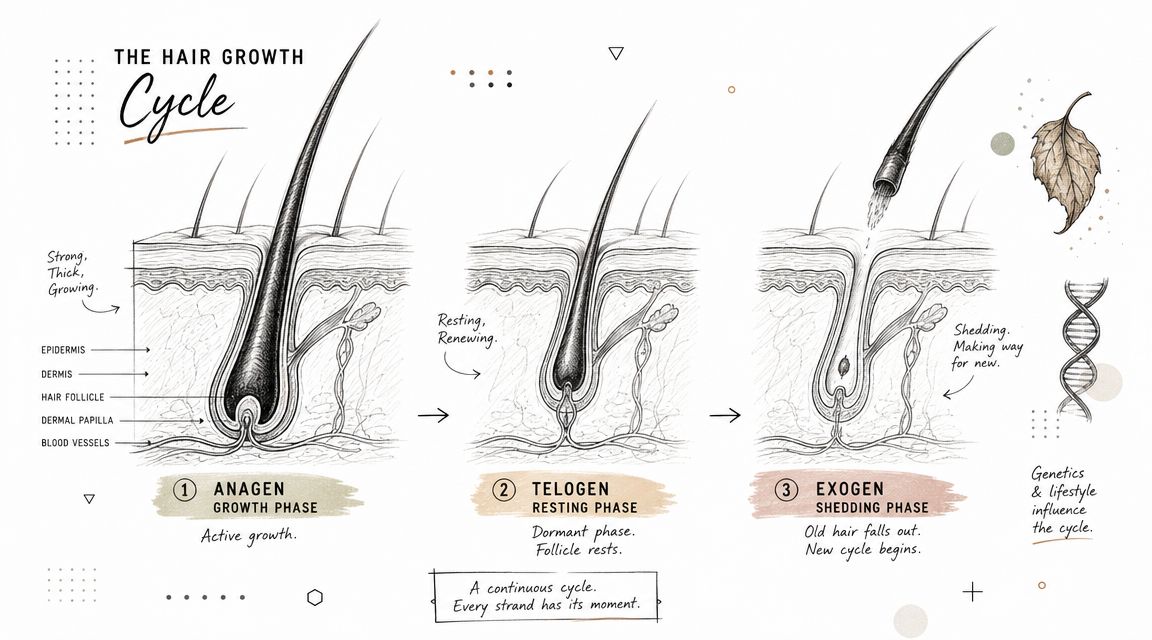
One of the most common causes is androgenetic alopecia, often called pattern hair loss. The British Association of Dermatologists notes that this affects about 50% of men over 50 and around 40% of women by the same age, which is why identifying the cause matters before choosing treatment, as discussed in this clinical review on common hair loss patterns and newer topical actives.
The main reason treatment plans differ
I often explain thinning hair like a garden with different problems in different beds. One area may have plants that are alive but underperforming. Another may be shedding because of a temporary shock. Another may have spaces where growth has reduced so far that you need replanting rather than fertiliser.
That's why one person does well with minoxidil and careful follow-up, while another is a stronger candidate for PRP, and another is best served by transplant surgery. The label “hair thickening treatment” covers all of these, but the biology underneath isn't the same.
What thickening really means
This is the expectation-setting part people need to hear clearly. Thickening usually means improving visible density, protecting miniaturising hairs, supporting better calibre, or making sparse areas look fuller. It does not usually mean creating unlimited new follicles where none are functioning.
Practical rule: The earlier the hair loss stage, the more likely treatment focuses on preservation and support. The later the stage, the more likely you need a structural solution.
That's also why timelines matter. Hair changes slowly. Even when treatment is working, you usually judge progress over months, not days. Patients do better when they know that from the start because they stop switching products too quickly and start looking for steady, realistic improvement.
Procedural Treatments for Lasting Hair Density
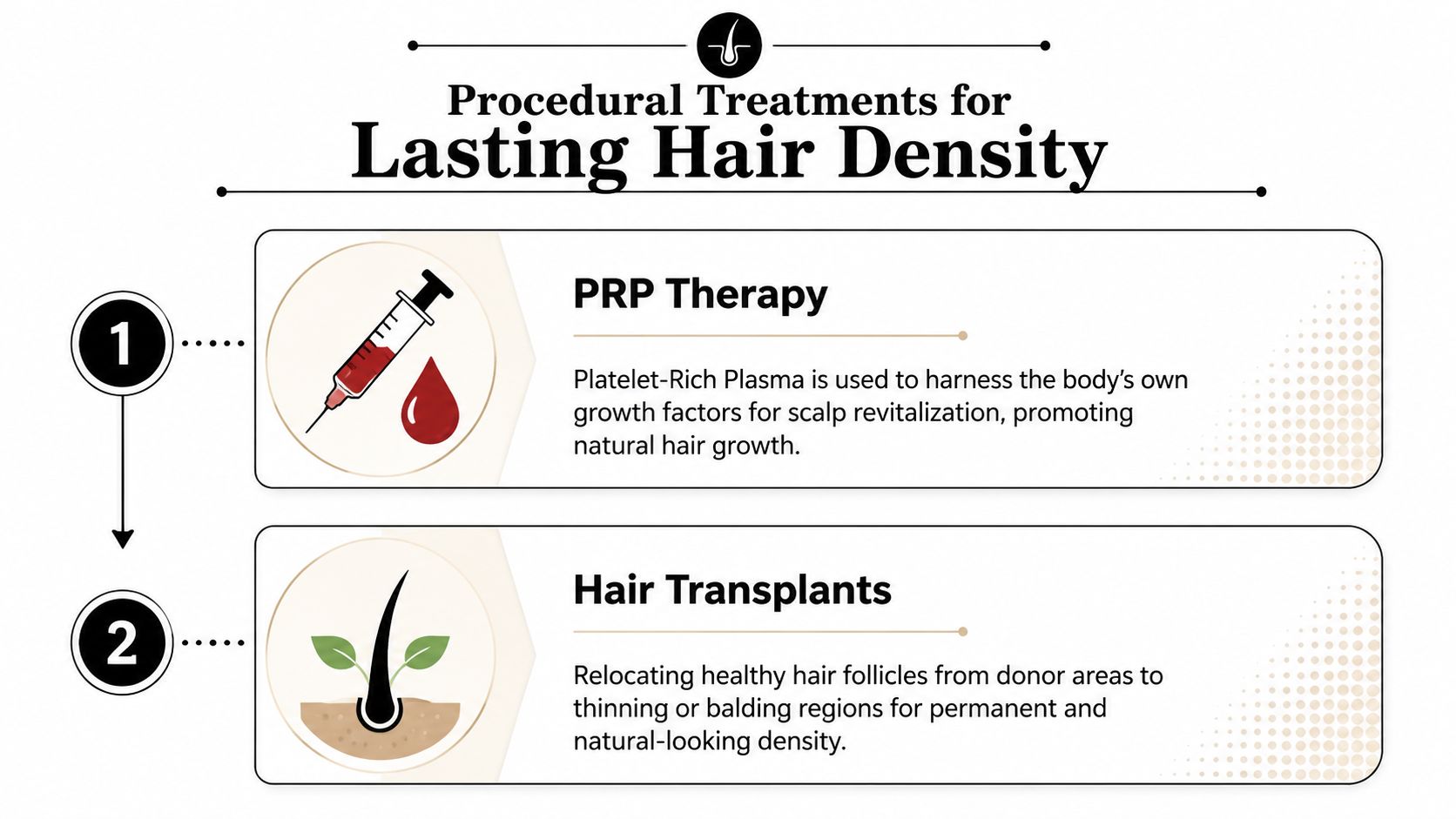
When thinning has moved beyond a minor cosmetic annoyance, procedural treatment often gives the clearest path forward. In clinic, the two options people ask about most are PRP therapy and hair transplantation. They're not interchangeable. They solve different problems and suit different stages of loss.
PRP therapy
Platelet-rich plasma, usually shortened to PRP, uses a concentrated portion of your own blood. The idea is straightforward. A small blood sample is taken, processed, and the platelet-rich portion is then injected into areas of thinning scalp.
The practical appeal is obvious. There's no donor harvesting, no surgical relocation of follicles, and no attempt to disguise the treatment as magic. PRP is usually considered when follicles are still present but underperforming. In other words, it tends to make more sense for thinning hair than for completely bald, shiny scalp where follicle activity may be minimal.
A typical patient journey looks like this:
- Assessment first. The scalp pattern is examined, the history is reviewed, and the goal is clarified. PRP works best when the question is “Can we support weaker hair?” rather than “Can we replace hair that's long gone?”
- Blood draw and preparation. A blood sample is taken and spun to separate the platelet-rich component.
- Scalp treatment. The prepared PRP is injected into targeted thinning areas.
- Follow-up planning. Response is reviewed over time, often alongside medical therapy or scalp care.
Recovery is usually manageable because this is not surgery in the transplant sense. People may notice tenderness, mild swelling, or sensitivity at injection sites, and many return quickly to normal routines. The main trade-off is patience. PRP tends to be a gradual support treatment, not an overnight density switch.
Where PRP works best is in combination thinking. It can sit alongside topical medication, oral medication where appropriate, and general scalp management. If you're exploring a clinic-based option for thinning rather than advanced baldness, PRP treatment to prevent hair loss gives a clearer picture of how this kind of plan is usually positioned.
PRP makes the most sense when there is hair to strengthen, not just skin to cover.
The limitation is important. PRP doesn't relocate follicles. It doesn't redraw a severely depleted hairline on its own. If someone expects a transplant-style result from PRP, they're likely to be disappointed.
Hair transplants
A hair transplant is a structural procedure. Instead of trying to thicken a visibly empty area by product alone, the surgeon moves follicles from a donor area, usually at the back or sides of the scalp, into thinning or bald regions. As a treatment concept, that matters because it changes where functioning follicles are placed.
This is why transplants can create a substantial visual difference in the right candidate. They don't biologically turn fine vellus hair into a dense teenage hairline everywhere. They redistribute available donor resources in a planned way. Good transplant work depends on design, donor quality, placement, and realistic density goals.
The patients who tend to benefit most usually share a few features:
- Stable pattern loss with a recognisable distribution
- Usable donor hair in the permanent zone
- Realistic expectations about density, coverage, and hairline design
- Willingness to maintain remaining native hair so the result ages well
The process is more involved than PRP. It begins with planning the hairline and recipient areas, then harvesting follicles from the donor zone, then implanting grafts into the target area. Recovery includes visible signs at first, and transplanted hair follows a growth timeline that requires patience. The final cosmetic payoff can be strong, but this is not a lunchtime treatment.
A point many patients appreciate once it's explained clearly is this: a transplant increases apparent density by moving follicles from one area to another. It does not create extra donor hair. That donor supply is finite, so planning matters. Overaggressive hairlines in the wrong candidate can look impressive briefly and problematic later.
For people considering this route, hair transplant treatment options in Essex show what this category of care involves in practical terms.
Which procedure suits which stage
PRP and transplant surgery often get compared as if one must be “better”. That isn't the right question. The useful question is whether you need support for living follicles or redistribution of donor follicles.
A simple way to grasp this is:
| Procedure | Usually suits | Main strength | Main limitation |
|---|---|---|---|
| PRP | Early to moderate thinning | Supports weakened areas without surgery | Won't recreate density where follicles are largely absent |
| Hair transplant | More established loss with a good donor area | Rebuilds visible density by relocating follicles | Needs planning, recovery, and ongoing maintenance of native hair |
Some treatment plans combine both. A person may use PRP or medication to protect surrounding native hair and consider transplantation for the most visibly depleted zones. That layered approach is often more logical than relying on one intervention to do everything.
Medical Therapies to Fight Hair Loss
Not everyone needs a procedure first. For many patients, especially those in earlier stages of thinning, medical therapy is the backbone of hair thickening treatment. It either protects hair that's being miniaturised, encourages better growth conditions, or supports the result of procedural care.
Clinical research gives a useful benchmark for what “working” can look like. In one placebo-controlled study, the average number of terminal hairs in the target area increased from 271 to 609 after 6 months of treatment, as reported in this clinical study on hair density change over time. That matters because it shows measurable improvement is possible, but it also reminds patients that results develop over months.
Minoxidil
Minoxidil is one of the most established options in this category. In UK practice, it's commonly used as an over-the-counter treatment. The appeal is that it can be started relatively early, used at home, and paired with other approaches.
The challenge is consistency. Minoxidil only helps if it's used as directed and continued. Many people stop too soon because they expect immediate cosmetic fullness. Others use it irregularly, then decide it “didn't work” when what failed was adherence.
What I tell patients is simple:
- Use matters more than enthusiasm. Starting strongly for two weeks and then forgetting it won't tell you much.
- It supports active follicles. It's not a substitute for transplant surgery in areas where follicle activity is minimal.
- It's often part of a longer plan. Good treatment usually looks boring in the short term and rewarding later.
Finasteride
Finasteride is a prescription option and is usually discussed differently because it requires proper medical review. It's often considered when the aim is not just thickening appearance, but slowing the ongoing pattern-loss process that keeps shrinking susceptible follicles.
The biggest practical point with finasteride is maintenance. If it's suitable and effective, it generally has to be taken continuously to maintain benefit. That makes it a commitment treatment, not a one-off correction.
In this context, honest discussion matters most. Some patients want the strongest evidence-based medical route and are comfortable with prescription monitoring. Others prefer not to use it and would rather focus on topical therapy, procedural support, or cosmetic management. A good consultation doesn't force one answer. It matches the plan to the person.
Light based support and combination care
Low-level light devices are often marketed aggressively. Some people find them helpful as part of a broader support plan, but in clinic I treat them as adjuncts, not centrepieces. If a patient is relying on a cap or comb while ignoring established medical options, they may be spending effort in the wrong place.
The strongest evidence-based options for medical hair thickening in the UK are generally considered to be minoxidil, finasteride, PRP, and hair transplantation, while cosmetic thickening products do not biologically alter hair growth, as noted later in this guide from a treatment comparison perspective.
If a treatment only makes your hair look fuller for the day, that can still be useful. It just belongs in a different category from treatment that aims to change the biology.
Combination plans are often the most sensible. That might mean minoxidil with PRP for someone trying to preserve density, or medication alongside transplant planning for someone with progressing pattern loss. Essex Boys Medical Group offers clinic-based care in this area, including PRP and transplant-focused pathways, but the right choice always depends on stage, scalp pattern, and expectations rather than brand loyalty.
Cosmetic Solutions for Instant Apparent Thickness
Cosmetic products occupy an important place because not every patient wants a medical route immediately, and even those who do often want something that helps now. Hair fibres, tinted scalp sprays, root camouflage products, and volumising shampoos can all improve the appearance of fullness without changing the underlying growth cycle.
What these products do well
They're fast. That's their main advantage.
If someone has an event, regular stage work, on-camera appearances, or desires less scalp show-through under bright light, cosmetic options can make a visible difference within minutes. Fibres cling to existing hairs and reduce contrast between hair and scalp. Tinted sprays soften sparse-looking areas. Volumising shampoos improve lift and texture, which can make thin hair look more substantial.
Used intelligently, they can also reduce anxiety while medical treatment is taking time to work.
Where people get disappointed
The disappointment starts when concealment is mistaken for treatment. These products don't preserve follicles, reverse pattern loss, or rebuild a depleted hairline. They wash out, wear off, or depend on there being enough existing hair for them to grip or blend into.
A sensible way to use cosmetic thickening is as a bridge:
- For immediate confidence before a meeting, performance, wedding, or photoshoot
- Alongside medical treatment while waiting for gradual biological improvement
- Instead of medical treatment, if your priority is appearance only and you're comfortable with that trade-off
That distinction matters. There's nothing wrong with cosmetic help. It's only a problem when someone thinks they're treating progression when they're only covering it.
Comparing Your Hair Thickening Treatment Options
By the time patients reach this stage of the conversation, most don't need more marketing. They need a sorting method. The simplest one is to ask three questions. Are you trying to hide thinning quickly, preserve hair that's still there, or rebuild density in areas that have already thinned significantly?
For medical hair thickening in the UK, the strongest evidence-based options are generally considered to be minoxidil, finasteride, PRP, and hair transplantation, while cosmetic thickening products do not biologically alter hair growth, according to this overview of hair thickening methods and their practical limits. If you want a second practical comparison of clinic and non-clinic routes, this overview of PRP For HairLoss treatments is useful for broad orientation.
Hair Thickening Treatment Comparison
| Treatment | Best For | Cost Level | Results Timeline | Type |
|---|---|---|---|---|
| Minoxidil | Early thinning and ongoing maintenance | £ | Gradual, usually months | Medical |
| Finasteride | Pattern hair loss where prescription treatment is appropriate | £ | Gradual, usually months | Medical |
| PRP | Thinning hair with active follicles that may benefit from support | ££ | Gradual, usually months | Procedural |
| Hair transplant | Established thinning or bald areas with a suitable donor zone | £££ | Longer-term, usually many months | Procedural |
| Hair fibres and tinted sprays | Quick cosmetic coverage | £ | Immediate | Cosmetic |
| Volumising shampoos and styling products | Mild apparent fullness | £ | Immediate but temporary | Cosmetic |
If you're weighing options with a treatment mindset rather than a product mindset, hair loss treatment options in Essex can help frame what tends to fit different stages of loss.
How to choose without wasting time
If your thinning is recent and diffuse, start by clarifying whether the follicles are still active and whether medical support is the logical first move. If the issue is mainly visual, with scalp peeking through but hair still present, cosmetic support plus medical treatment often makes sense.
If the frontal hairline or crown has become clearly depleted, ask a more direct question. Are you trying to stimulate weaker hair, or are you trying to cover an area that now lacks enough viable follicles to give a satisfying result without transplantation? Patients save themselves months of frustration when they answer that question candidly.
A few decision rules help:
- Choose cosmetic help when your priority is speed and appearance.
- Choose medical therapy when your priority is preservation and gradual improvement.
- Choose procedural care when your priority is structural change and your pattern of loss suits it.
- Choose combination treatment when one method alone won't realistically meet your goal.
The wrong treatment isn't always a bad treatment. Often, it's a good treatment used for the wrong stage.
Start Your Hair Restoration Journey in Essex
The hardest part for many people isn't treatment. It's deciding to stop guessing and get a proper assessment. Once that happens, the process usually becomes much less intimidating.
What happens at a proper consultation
A useful consultation should feel like clinical problem-solving, not a sales script. The first task is to understand the pattern. Is the thinning concentrated at the temples, crown, midline parting, or diffusely across the scalp? Has it been gradual or sudden? Is there shedding, breakage, or both? What treatments have already been tried, and for how long?
That review matters because the treatment plan follows the pattern. A person with early miniaturisation may be a medical candidate first. A person with a well-defined donor zone and established thinning may need a transplant discussion. Someone who mainly wants a realistic way to look better quickly may benefit from honest cosmetic guidance while considering next steps.
Questions also matter more than people expect. Ask what kind of result is realistic. Ask what maintenance will be needed. Ask what happens if you do nothing. Ask whether the plan is trying to preserve, improve, or replace hair in a thinning area.
The best consultation is the one that leaves you with clarity, even if the answer is “not yet” or “not this treatment”.
When taking action makes sense
People often wait for the problem to become “bad enough”. Clinically, that isn't always helpful. Thinning is usually easier to manage when there is still enough active hair to support. That doesn't mean everyone should rush into treatment, but it does mean delay can reduce your non-surgical options.
A well-run assessment should leave you with a staged plan. Sometimes that means starting conservative and reviewing. Sometimes it means combining treatments. Sometimes it means deciding that a cosmetic strategy is enough for now. What matters is that the plan matches your stage, your goals, and the kind of upkeep you're willing to commit to.
If you want a clear, medically grounded next step, book a consultation with Essex Boys Medical Group. You'll be able to discuss your pattern of thinning, whether PRP, transplant planning, or medical therapy is appropriate, and what kind of result is realistic for your scalp rather than for someone else's.
Created with the Outrank tool
0 Comments