
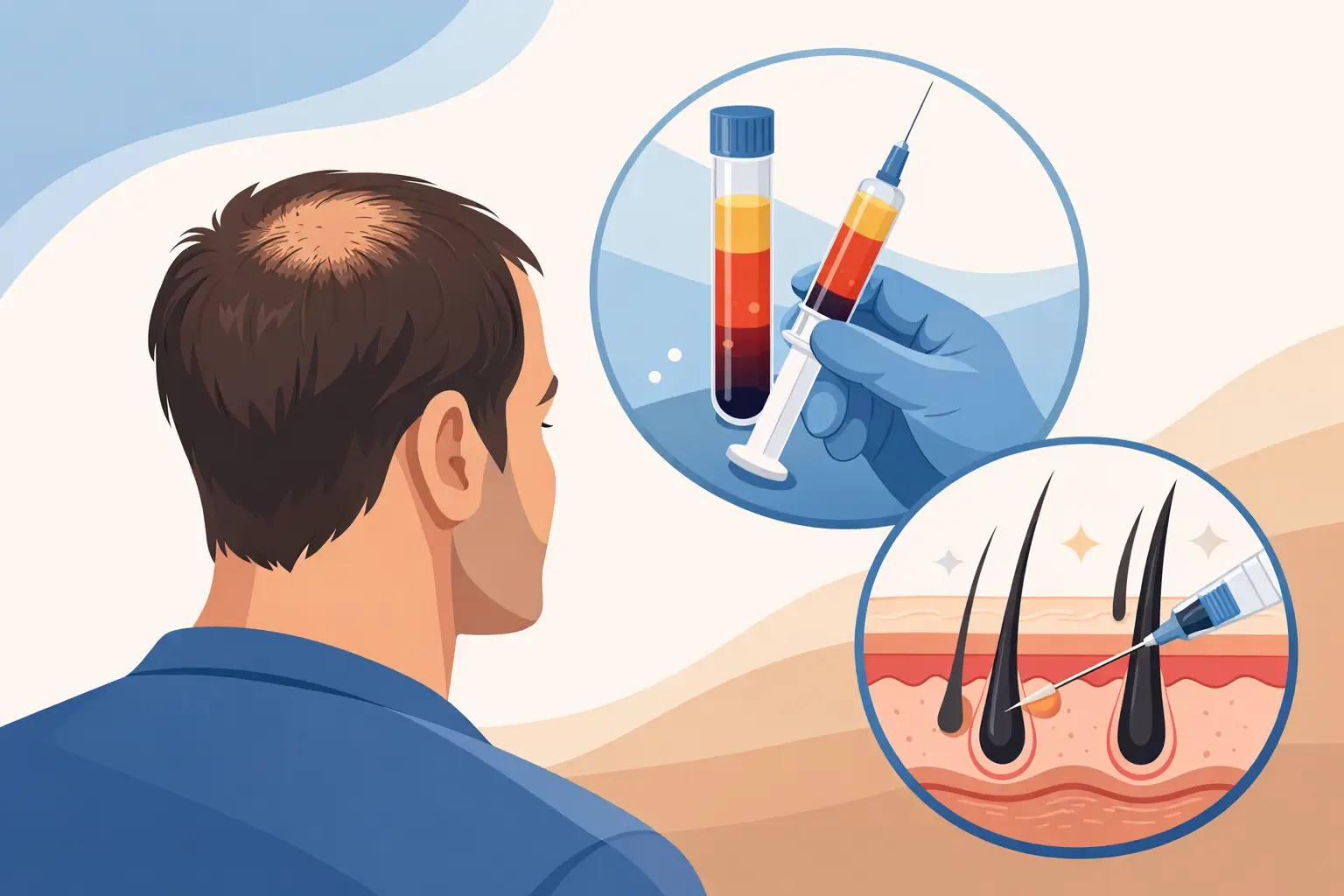
PRP (platelet-rich plasma) is a non-surgical treatment used for certain types of hair thinning. It uses platelet-rich plasma prepared from a small sample of the patient’s own blood and is intended to support existing hair follicles.
Suitability for PRP varies between individuals and depends on factors such as the cause and stage of hair loss, follicle activity, medical history and individual treatment goals.
For many adults, the first priority is simple – find a treatment that fits real life. You want visible improvement, minimal disruption, and a clinic-led approach that feels credible. PRP has become a strong option for men and women who want to act early, protect existing hair, and improve confidence without committing straight away to surgery.
What is hair thinning treatment PRP?
PRP stands for platelet-rich plasma. The treatment uses a small sample of your own blood, which is processed to separate the platelet-rich portion. That concentrated plasma is then injected into targeted areas of the scalp where hair is thinning.
The reason this appeals to so many patients is straightforward. Platelets contain growth factors that may help stimulate weakened follicles, improve the scalp environment, and support better hair quality over time. PRP does not create a brand-new hairline overnight, and it is not a miracle fix for advanced baldness. What it can do is help encourage struggling follicles to perform better, which may lead to thicker, stronger, healthier-looking hair.
This makes it especially attractive for people in the earlier stages of hair loss, or for those who have noticed reduced density rather than complete loss in one area.
Who is PRP best suited for?
Hair thinning rarely looks the same from one person to the next. Some patients notice widening at the part line. Others see recession around the hairline or more scalp visibility through the crown. PRP is often best for patients who still have active follicles in the treatment area.
That matters because PRP works by supporting what is still there. If follicles are miniaturizing but not fully inactive, treatment may help strengthen them. If an area has been smooth, bare, or dormant for a long time, the response may be limited. In those cases, a hair transplant may be the better route, or PRP may be used as part of a broader hair restoration plan.
It can also be a good fit for patients who want a more natural, low-downtime option, or for those who are not ready for surgical treatment. For some people, it works well alongside other medical hair loss strategies. The right answer depends on the pattern of thinning, how long it has been happening, and what result you realistically want.
How hair thinning treatment PRP works in practice
The process is usually quick and clinic-based. A blood sample is taken first. That sample is then spun in a centrifuge to isolate the platelet-rich plasma. Once prepared, the PRP is injected into the scalp in the areas being treated.
Most patients tolerate the procedure well. You may feel some brief discomfort from the injections, but it is generally manageable and does not usually involve significant downtime. Mild tenderness, redness, or sensitivity afterward can happen, but these effects are typically short-lived.
The practical advantage is clear – you can return to normal routines quickly. For busy professionals, parents, or anyone who does not want the visibility and recovery of a more invasive treatment, that convenience is a major part of the appeal.
What results can you expect?
This is where honest expectations matter. PRP is designed to improve hair quality, reduce the progression of thinning in some patients, and support better density over time. It is not a one-session transformation, and results vary from person to person.
Patients often hope for immediate thickening, but hair growth works on a cycle. Improvements usually take time to become noticeable. In many cases, the early signs are less shedding, a healthier scalp feel, or hair that appears stronger and fuller in texture. More visible improvement in density can take several months.
The best results tend to happen when treatment starts before thinning becomes severe. If you still have a good amount of existing hair but it has become finer, weaker, or flatter, PRP may give you a meaningful improvement. If you are looking to restore large areas of missing hair, it may not be enough on its own.
PRP vs other hair loss options
Patients comparing treatments usually want to know one thing – is PRP worth it compared with everything else? The answer depends on your stage of hair loss and your goals.
Compared with topical or oral treatments, PRP appeals to people who want a clinic-based procedure using their own blood rather than a daily at-home routine. That does not automatically make it better. Some patients prefer the consistency and lower upfront cost of medication, while others like the idea of targeted in-clinic support.
Compared with a hair transplant, PRP is far less invasive and involves much less downtime. But a transplant is designed to move healthy follicles into areas where hair has already been lost. PRP cannot replace that function. It is better viewed as a treatment for preservation and enhancement, not a substitute for surgical restoration in advanced cases.
In some plans, these treatments are not in competition at all. They can complement each other. A patient might use PRP to support thinning hair now, or to help maintain and improve the quality of existing hair around a transplant area later.
Why timing matters with PRP hair treatment
One of the biggest mistakes people make is waiting until thinning has become obvious in every photo and every mirror. Hair loss often progresses gradually, which makes it easy to delay action. By the time a patient seeks help, some follicles may already be too weakened to respond as well as they could have earlier.
That is why an early consultation can make a real difference. If thinning is recent, patchy, or mild to moderate, the treatment window is often more favorable. Acting sooner can give you more options, not fewer.
This is also where a proper assessment matters. Thinning can be linked to male pattern hair loss, female pattern thinning, stress, hormonal changes, post-pregnancy shedding, or other medical factors. PRP may be suitable in some of these cases, but not all. A professional evaluation helps avoid wasted time and unrealistic expectations.
What to look for in a PRP provider
Not all aesthetic clinics approach hair restoration with the same level of care. If you are considering PRP, look for a provider with clear experience in scalp-based treatments, a strong consultation process, and a realistic approach to outcomes.
You want a clinic that explains whether you are a good candidate, not one that promises dramatic regrowth to everyone. Good treatment planning includes an honest view of your current hair density, likely response, the number of sessions you may need, and whether another solution would suit you better.
For patients who want a polished private treatment experience with straightforward access to hair restoration options, Essex Boys Medical Group reflects the kind of clinic model many people are looking for – professional, appearance-focused, and built around practical next steps.
Is hair thinning treatment PRP worth it?
For the right patient, yes. If your hair is thinning rather than gone, if you want a non-surgical option, and if you understand that improvement takes time, PRP can be a very worthwhile treatment. It offers a credible middle ground between doing nothing and moving straight to surgery.
It is not the cheapest option, and it does require commitment. Most patients need a course of treatment rather than a one-off visit, and maintenance may be recommended to keep results on track. That is the trade-off. You are choosing a regenerative, lower-downtime approach, but one that relies on consistency and realistic expectations.
Still, for many men and women, the value goes beyond the scalp itself. When your hair looks healthier, styling feels easier, photos feel less stressful, and confidence often follows. That matters.
If you have started noticing more scalp show-through, a weaker hairline, or less density than you used to have, PRP is worth exploring sooner rather than later. A tailored consultation can tell you whether it fits your pattern of thinning, your timeline, and the result you want to see. The smartest next step is not guessing – it is getting clear advice while your options are still wide open.
0 Comments