
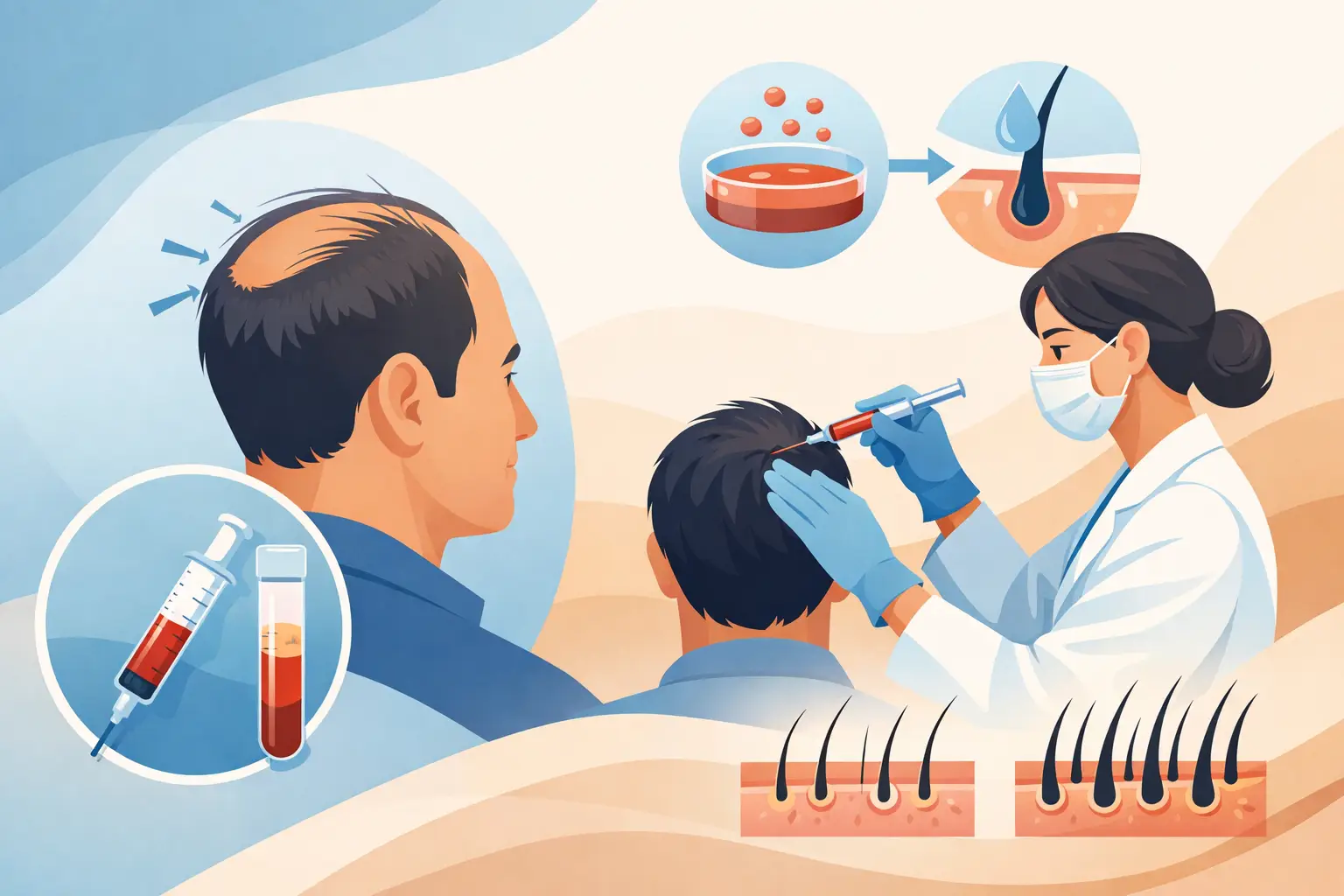
One of the most common questions about PRP hair treatment is how many sessions are typically needed. The answer varies between individuals, as treatment plans depend on factors such as the type and stage of hair loss, follicle activity and response to treatment.
How many sessions of PRP for hair loss are typical?
For most patients, the standard starting plan is 3 to 4 PRP sessions spaced about 4 to 6 weeks apart. That gives the scalp repeated stimulation over a short enough period to build momentum. After that initial phase, maintenance treatments are often recommended every 4 to 6 months, depending on how your hair responds and how active your hair loss is.
This is why the number varies from person to person. Someone with early thinning may do very well with three sessions and occasional upkeep. Someone with more noticeable shedding, longer-term pattern hair loss, or slower response may need a fuller course and more regular maintenance to keep results looking strong.
PRP is rarely a one-treatment fix. Hair loss is usually progressive, especially when genetics are involved, so treatment plans are built around improvement and maintenance rather than a permanent cure.
Why PRP usually takes more than one session
PRP stands for platelet-rich plasma. The treatment uses a concentrated portion of your own blood, prepared and injected into the scalp, with the aim of supporting dormant or weakened follicles. The goal is to create a healthier environment for hair growth and improve the quality of existing hair.
Hair grows in cycles, and those cycles take time to shift. A single PRP appointment may begin the process, but visible cosmetic change often needs repeated sessions. Think of it as a course designed to encourage consistency in the scalp, not an instant transformation after one visit.
That matters for expectations. If you want a treatment that works with your natural hair and can improve density without surgery, PRP can be appealing. But if you expect dramatic overnight regrowth in areas with long-standing baldness, you may be better suited to a different solution, such as a hair transplant.
What affects how many PRP sessions you may need?
The stage of your hair loss
Early hair thinning tends to respond better than advanced loss. If follicles are still active, even if they are producing finer, weaker hair, PRP has more to work with. If an area has been completely bald for a long time, PRP alone may not create the kind of visible regrowth many patients want.
The cause of the thinning
PRP is often used for androgenetic alopecia, commonly known as male or female pattern hair loss. It may also help with certain forms of diffuse thinning. If your shedding is linked to hormones, stress, illness, nutritional deficiencies, or scalp inflammation, the wider cause also needs to be addressed. Otherwise, you may need more sessions with weaker long-term benefit.
Your age and hair quality
Younger patients or those treating hair loss early often notice stronger improvement in thickness and texture. That does not mean older patients cannot benefit, but it can affect how quickly the scalp responds and how intensive the treatment plan needs to be.
Whether you combine PRP with other treatments
PRP can work well as part of a broader hair restoration strategy. Some patients combine it with medical hair loss treatments or use it after a hair transplant to support healing and growth. When combined properly, results can look better than PRP on its own, which may also influence how frequently sessions are advised.
What results can you expect after each stage?
After the first session, most people do not see a major visible change. That is normal. Some patients notice reduced shedding fairly early, but cosmetic improvement usually takes longer.
By the second or third session, you may start to see subtle changes in hair texture, strength, and fullness. Hair may feel healthier, easier to style, and less fragile. For many patients, the more noticeable change comes around the three to six month mark, when improved density begins to show.
The best candidates usually already have hair in the area being treated, but it has become thinner, finer, or weaker. PRP is at its best when it strengthens what is still there.
A realistic timeline for PRP hair treatment
A practical treatment timeline often looks like this.
During the first 3 to 4 months, you complete your initial course of sessions. Over the next 2 to 3 months, the scalp continues to respond. Around month 4 to 6, many patients can judge their early outcome more clearly. From there, maintenance helps preserve progress.
This slower build is one reason professional assessment matters. Stopping too early can mean you give up before results have had time to develop. On the other hand, continuing endlessly without reassessment is not the right approach either. A proper clinic should review your response and adjust the plan around your actual progress.
How do maintenance sessions work?
If your initial course goes well, maintenance becomes the next step. Many patients move to one session every 4 to 6 months. Some can stretch treatment out further, while others benefit from more regular visits, especially if their hair loss is active or genetically driven.
Maintenance is not a sign the treatment failed. It is part of managing a condition that usually continues over time. Much like skin treatments or fitness results, consistency plays a big role in keeping the improvement visible.
For image-conscious patients, this is often a worthwhile trade-off. You are not just chasing regrowth. You are protecting hair quality, slowing visible thinning, and keeping your appearance sharper over the long term.
When PRP may not be enough on its own
PRP is attractive because it is minimally invasive and uses your own plasma, but it has limits. If you have extensive bald patches, a very receded hairline, or severe follicle loss, you may not get the density you want from injections alone.
That does not mean PRP has no place. In some cases, it is used to support overall scalp health while another treatment plan is considered. For patients wanting a stronger cosmetic change, a transplant may offer a more dramatic result, while PRP can help maintain surrounding native hair.
This is where an honest consultation matters. The right plan should be based on what will actually improve your appearance, not just what sounds easiest.
Is PRP worth it if you need several sessions?
For many patients, yes, especially if catching hair loss early is a priority. The value is not just in whether new growth appears. It is also in reducing shedding, improving thickness, and helping your hair look fuller and healthier.
The key is to judge PRP properly. If your aim is to strengthen thinning hair, preserve your look, and avoid the need for more aggressive intervention too soon, multiple sessions can make sense. If your aim is to restore a completely bald area, expectations need to be different.
At a clinic such as Essex Boys Medical Group, the best PRP plans are built around visible aesthetic improvement and realistic long-term maintenance, so patients know what they are investing in and why.
Questions to ask before starting PRP
Before you begin, ask how many sessions are being recommended and why. Ask when results are usually reviewed, whether maintenance is expected, and what kind of improvement is realistic for your stage of hair loss. You should also ask whether PRP is the best option for you alone or whether another treatment could produce a better cosmetic outcome.
That kind of clarity matters. Good treatment is not only about getting injections. It is about having a plan that fits your hair, your goals, and the way you want to look.
If you are considering PRP, the best time to act is usually when thinning is noticeable but not yet advanced. Earlier treatment often gives you more options, better retention of existing hair, and a stronger chance of keeping your overall look confident and well put together.
0 Comments