
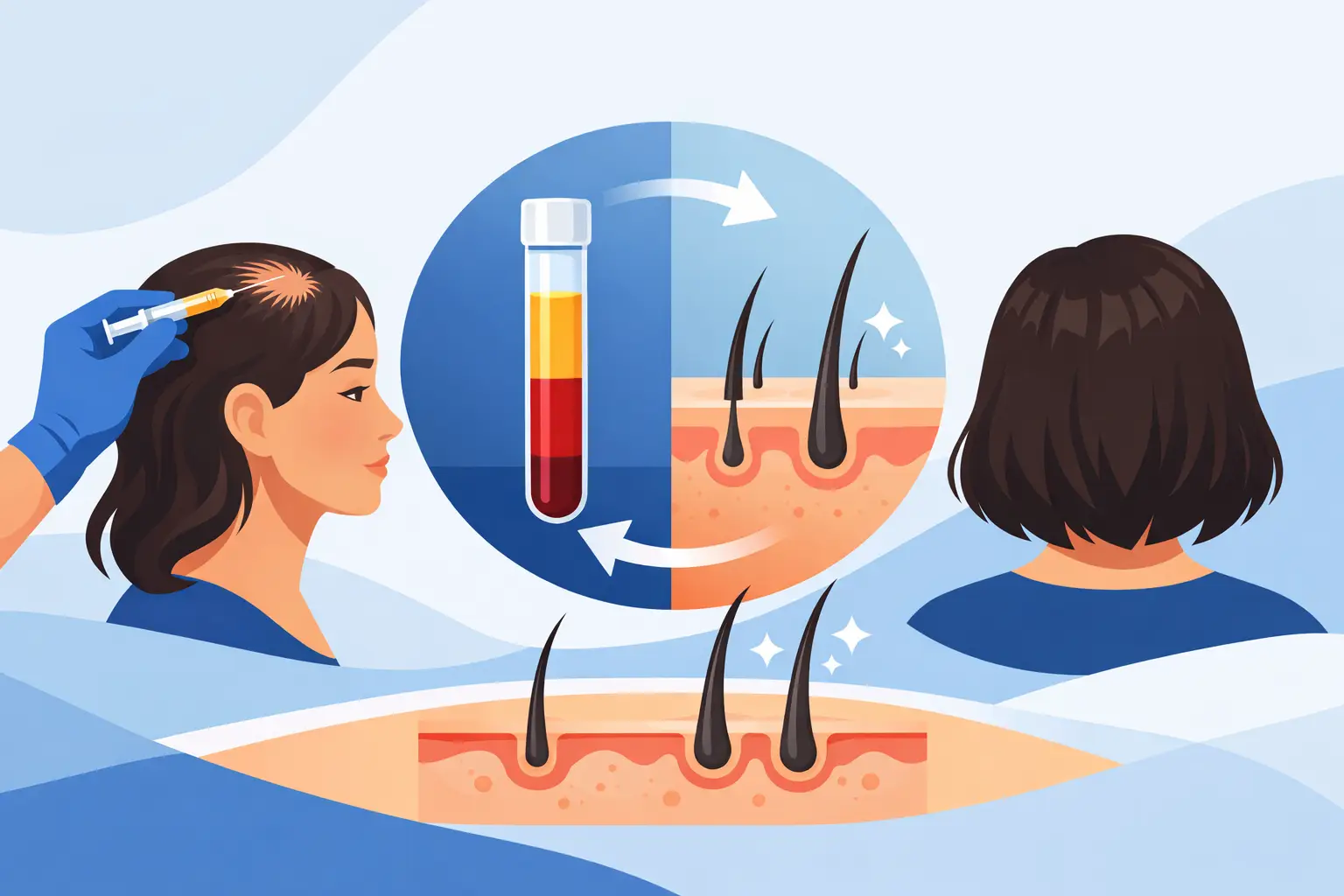
PRP (platelet-rich plasma) is a non-surgical treatment that may be considered for certain types of hair thinning. It uses a concentrated portion of a patient’s own blood containing platelets and associated growth factors.
This guide explains how PRP hair treatment works, what happens during an appointment, who may be suitable and some of the factors that can influence individual response to treatment.
How PRP hair treatment works
PRP stands for platelet-rich plasma. Platelets are small components of your blood that contain proteins known as growth factors. These growth factors play a role in the body’s natural repair processes, including cell signaling and tissue healing.
During PRP treatment, a small blood sample is taken, much like a routine blood draw. The sample is placed in a centrifuge, which spins it at high speed to separate its components. This allows the practitioner to collect plasma with a higher concentration of platelets than is found in whole blood.
That platelet-rich plasma is then carefully injected into areas of the scalp where hair is thinning. The aim is to create a healthier environment around weakened but still active hair follicles. PRP may help support follicle activity, improve blood supply around the follicles, and encourage hairs to spend longer in their active growth phase.
The treatment does not create brand-new follicles where none remain. Instead, it is intended to support follicles that are dormant, shrinking, or producing finer hairs. This is why timing matters. In many cases, PRP is most useful when hair thinning is noticed early rather than after an area has become completely bald and smooth.
What happens during a PRP hair appointment?
A PRP hair treatment appointment is straightforward and usually completed without surgery or significant downtime. Your practitioner will first assess your scalp, hair density, pattern of loss, and medical history. This step matters because thinning hair has several possible causes, from hereditary pattern hair loss to stress, nutritional deficiencies, illness, hormone changes, or scalp conditions.
After your blood is drawn and processed, the scalp is prepared and the PRP is injected into targeted areas. A topical numbing product may be used to improve comfort. You may feel brief pressure or pinching during the injections, particularly around the hairline or crown, but most patients find the procedure manageable.
Appointments often take around 45 to 60 minutes, depending on the treatment area and the approach recommended by your practitioner. Mild tenderness, tightness, or small areas of redness can occur afterward. Because PRP comes from your own blood, the risk of an allergic reaction is low, although any injection treatment carries a small risk of bruising, swelling, infection, or discomfort.
Most people can return to their usual routine shortly after treatment. Your provider may ask you to avoid washing your hair for a short period, intense exercise that day, alcohol, smoking, anti-inflammatory medication, or harsh scalp products. Follow the specific aftercare instructions you are given, as recommendations can vary.
When will you see results from PRP hair treatment?
PRP works gradually because the hair growth cycle moves gradually. You should not expect a dramatic change after one session. Some people first notice reduced shedding or a healthier appearance to their existing hair, while visible improvements in thickness may take several months.
A common starting plan involves a series of treatments spaced several weeks apart, followed by maintenance sessions if appropriate. The exact number of sessions depends on your hair loss pattern, the quality of your existing follicles, your response to treatment, and whether PRP is being combined with another hair restoration plan.
Results vary. Some patients see a noticeable improvement in density and hair quality, especially when they begin treatment while thinning is still mild to moderate. Others may experience more modest change. Your genetics, age, health, stress level, hormonal factors, and consistency with recommended treatment all influence the outcome.
PRP should be viewed as a commitment to supporting your hair over time, not as a one-time fix. A good consultation should set realistic expectations based on your scalp, not sell a guaranteed result.
Who is a good candidate for PRP hair treatment?
PRP can be a strong option for men and women with early-stage thinning, a receding hairline, widening part, diffuse thinning, or hereditary pattern hair loss. It may also be considered for people looking to support natural hair growth after a hair transplant, where the goal is to help the surrounding native hair look fuller and healthier.
The best candidates usually have active hair follicles in the treatment area. If follicles have been absent for a long time, PRP alone is unlikely to restore meaningful coverage. In that situation, a hair transplant or a different treatment strategy may be more suitable.
A thorough assessment is especially valuable if your shedding began suddenly. Rapid shedding can sometimes be connected to an underlying issue that should be addressed first, such as iron deficiency, thyroid concerns, recent illness, medication changes, or significant stress. Treating the cause of shedding is just as important as treating its visible effect.
PRP may not be appropriate for everyone. Your practitioner should know if you have a bleeding or platelet disorder, an active scalp infection, certain autoimmune conditions, cancer, or if you take blood-thinning medication. Pregnancy and breastfeeding may also affect whether elective treatment is advised. Honest medical screening helps keep your plan safe and tailored to you.
PRP alone or combined with other hair restoration options?
For some people, PRP is a stand-alone treatment. For others, it works best as part of a wider plan. Medications such as minoxidil, prescribed hair-loss treatments, lifestyle changes, and transplant surgery can all have a role depending on the cause and stage of hair loss.
Combining treatments can make sense when the goal is both immediate improvement and long-term preservation. For example, a transplant can move permanent follicles into a thinning area, while PRP may help support existing hair around it. However, more treatment is not automatically better. The right plan depends on what your scalp needs, your budget, and how much maintenance you are comfortable with.
Be cautious of claims that PRP can permanently reverse every type of hair loss or replace a transplant in advanced baldness. The treatment has promising uses in hair restoration, but it is not a cure for every cause of hair loss. A credible provider will explain both its potential and its limits.
Is PRP hair treatment worth considering?
For the right person, PRP offers an appealing middle ground between doing nothing and choosing surgery. It uses your own blood, requires little downtime, and can be repeated as part of a long-term hair confidence plan. It is particularly attractive for people who want to keep their treatment discreet and preserve natural-looking results.
The value comes from a properly selected treatment plan. If you still have active follicles and want to address thinning before it becomes more visible, PRP may be a practical way to invest in your appearance and confidence. If your hair loss is more advanced, the consultation may point toward a transplant or a combination approach instead.
Your hair deserves more than guesswork. A professional scalp assessment can identify what is driving your thinning and help you choose the option that gives you the most realistic path toward fuller-looking hair.
0 Comments