
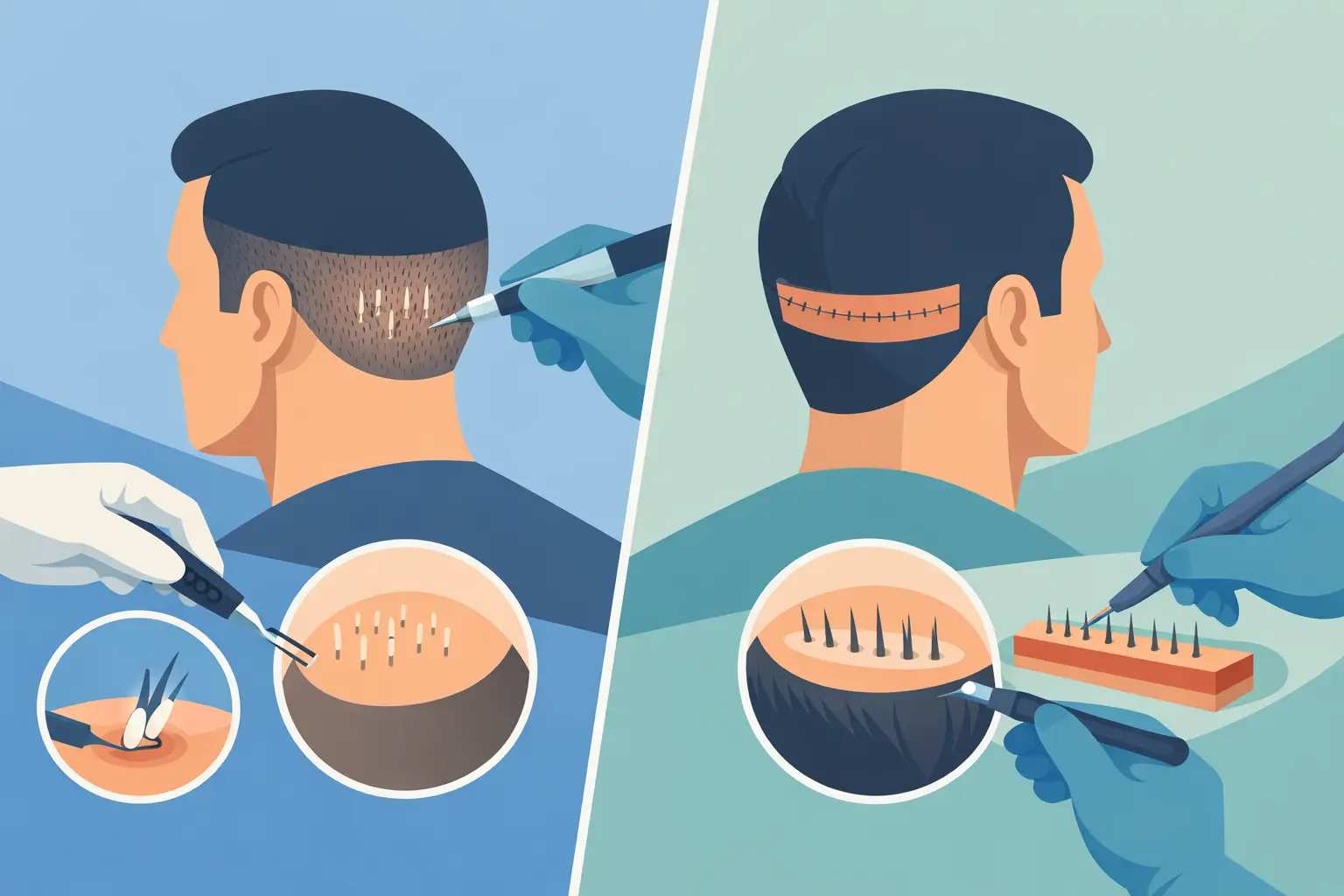
A hair transplant should suit your hair loss pattern, lifestyle, and goals – not simply follow the procedure with the best marketing. When considering an FUE versus FUT hair transplant, the key difference is how donor hair is collected from the back and sides of the scalp. Both techniques can create a natural-looking hairline and fuller coverage when they are planned well. The right choice comes down to your donor supply, the number of grafts needed, your preferred haircut, and how you feel about recovery and scarring.
For people who have spent years avoiding photos, styling around thinning areas, or feeling less like themselves in the mirror, that decision can feel personal. A clear consultation turns it into a practical one.
FUE versus FUT hair transplant: the real difference
FUE stands for Follicular Unit Extraction. With this method, individual follicular units are removed one at a time using a small punch tool. These grafts are then placed into the thinning or bald area according to the treatment plan. Because there is no linear strip removed from the scalp, FUE leaves many tiny dot scars rather than one longer scar.
FUT stands for Follicular Unit Transplantation. It is also known as the strip method. A narrow strip of donor-bearing skin is removed from the back of the scalp, and the follicular units are carefully separated under magnification before being transplanted. The donor area is closed with stitches or staples, leaving a linear scar that is usually hidden by longer surrounding hair.
Neither approach is automatically better. Both use your own permanent donor hair, and both depend on careful graft handling, realistic planning, and an experienced medical team. The best procedure is the one that preserves your donor area while giving you the coverage and hairline design that fit your appearance goals.
Why patients choose FUE
FUE is often appealing to patients who prefer short hairstyles or want to avoid a linear scar. The small extraction sites usually heal quickly, and the donor area can be less noticeable once the hair grows back in. This makes FUE a popular choice for people who wear a close fade, keep their hair short, or want flexibility in how they style it later.
It can also be a good option for patients who need a modest number of grafts for a receding hairline, temple restoration, or early crown thinning. FUE can be used across more than one session, which may suit someone whose hair loss is progressing gradually and who wants to manage treatment over time.
That said, FUE is not scar-free. Tiny white dots can be visible if the head is shaved very closely, especially in patients with contrast between scalp and hair color. Removing too many grafts too close together can also make the donor zone look thinner. Extraction patterns, graft spacing, and a conservative approach to donor management matter just as much as the technique itself.
FUE recovery and expectations
Most FUE patients have small scabs in the transplanted and donor areas for around one to two weeks. Temporary redness, swelling, and tenderness are common in the early days. You will need to avoid rubbing the grafts, strenuous exercise, swimming, and direct sun exposure while healing instructions are in place.
The transplanted hairs often shed after the procedure. This is expected and does not mean the grafts have failed. New growth commonly begins to appear after several months, with visible improvement building gradually. Final maturation can take 12 months or longer, particularly in the crown area.
Why patients choose FUT
FUT can be an effective choice when a patient needs a larger number of grafts in one session. Because grafts are dissected from a strip under controlled conditions, FUT may allow efficient harvesting while preserving a strong number of follicular units. For advanced hair loss, this can be valuable when the goal is to create meaningful frontal coverage and density without overworking the donor area.
The technique can also be appropriate for people who normally wear their hair at a medium length or longer, where the linear scar is likely to remain concealed. For the right candidate, FUT can provide excellent graft yield and natural-looking results.
The trade-off is clear: the donor scar is longer. Although it often fades over time, it may be visible with very short haircuts or a shaved head. There can also be more tightness or discomfort in the donor area during the first stage of healing compared with FUE. If you know you want to wear a close-cropped style, this should be part of the conversation from the start.
FUT recovery and expectations
Recovery after FUT includes caring for the incision line and returning for stitch or staple removal if required. Patients are generally asked to take it easy initially, particularly with exercise, bending, and activities that could put tension on the donor area.
As with FUE, the transplanted hairs may shed before new growth begins. The result develops in stages, not overnight. A well-designed transplant should look better as it grows, blend with your existing hair, and still make sense if further thinning happens in the future.
Scarring, haircut choices, and donor supply
Scarring is one of the biggest practical differences between the two methods. FUE leaves scattered circular scars, while FUT leaves a narrow line. The question is not whether there will be a scar, but which scar pattern better matches the way you wear your hair and the amount of donor hair available.
Hair density, curl pattern, scalp flexibility, and hair color all affect how easily scars can be concealed. A patient with thick, wavy hair may have different options from someone with fine, straight hair and a very short preferred cut. Your specialist should assess the donor area in person rather than making assumptions from photographs alone.
Donor hair is limited. It is tempting to focus only on the number of grafts that can be placed today, but long-term planning is more attractive and more responsible. A natural hairline at age 35 should still look appropriate at 50. Preserving donor reserves may be essential if hair loss continues or a future procedure is needed.
Which procedure gives the best result?
A great result is not defined by FUE or FUT alone. It is defined by the quality of the assessment, the hairline design, the placement angle of every graft, and sensible expectations. A low, dense hairline may sound appealing, but it can look unnatural and consume too much donor hair if it does not suit your age, facial proportions, and likely pattern of future loss.
FUE may be the stronger fit if you value a short haircut, want to avoid a linear scar, or need focused work in a smaller area. FUT may be worth considering if you need a higher graft count, have good scalp laxity, and are comfortable keeping enough length to conceal a linear scar. Some patients may even benefit from a combined or staged approach, but only when it is clinically justified.
Medical treatment can also be part of the wider plan. Depending on the cause and stability of your hair loss, options such as PRP treatment or prescribed hair-loss medication may help support existing hair. A transplant redistributes hairs; it does not stop progressive thinning in untreated areas.
Questions to ask at your consultation
Ask how your donor area will be assessed, how many grafts are realistically available, and what the proposed hairline will look like as you age. You should also ask who performs each stage of the procedure, what aftercare is included, and what happens if your hair loss progresses.
Bring photos of haircuts you like, but stay open to professional advice. The most convincing result is usually one that looks like your own hair has returned, not one that looks overly engineered.
A personal assessment is the best next step when you are ready to make a confident decision. At Essex Boys Medical Group, the focus is on helping you understand your options, protect your donor hair, and choose a plan that lets you feel good when you look in the mirror.
0 Comments