
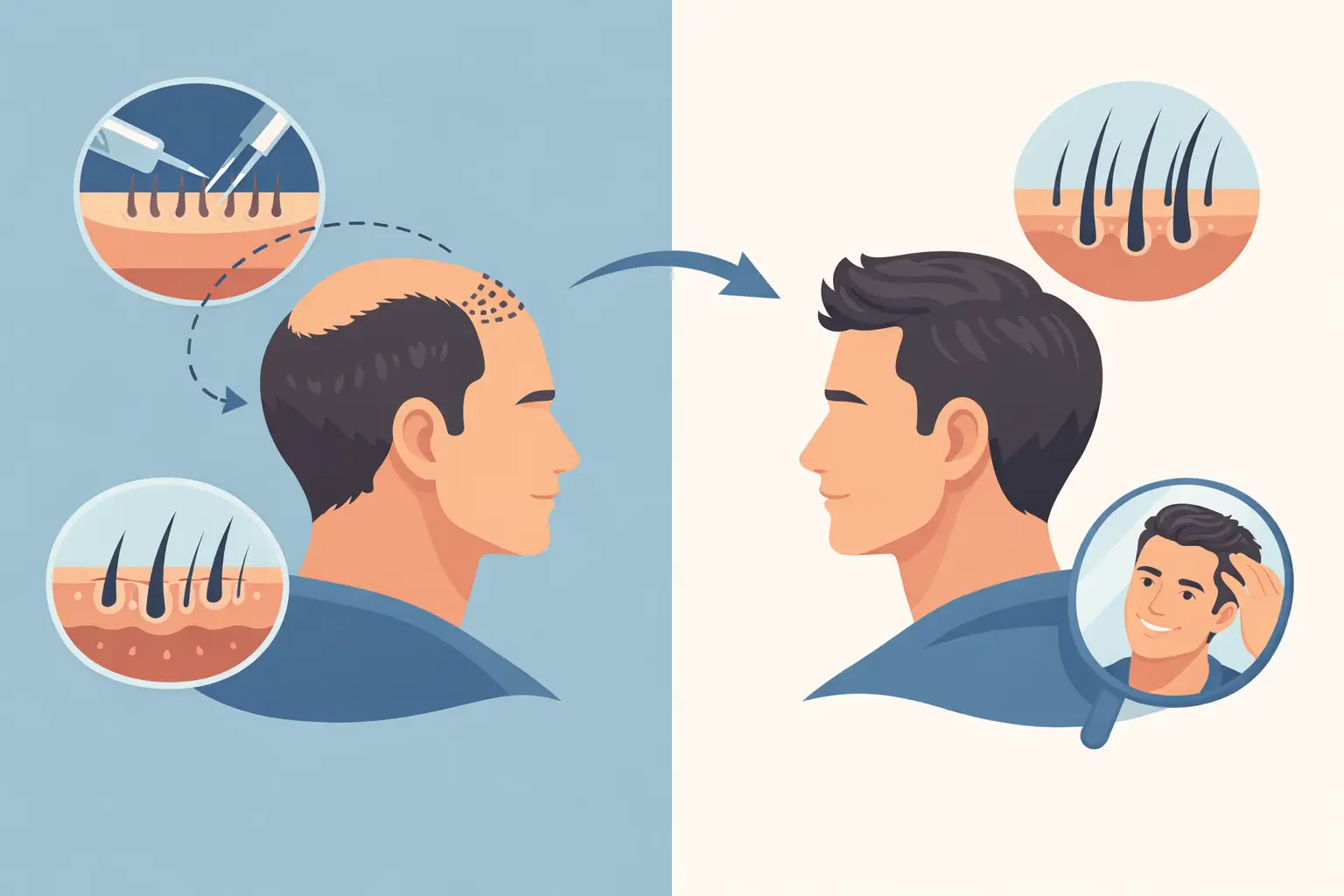
Hair transplant results develop gradually and can vary considerably between individuals. Factors such as the type and extent of hair loss, donor hair availability, hair characteristics, graft placement and the progression of future hair loss can all influence the outcome.
Understanding these factors can help patients develop realistic expectations about what hair transplant surgery may and may not achieve.
What Before and After Photos Can Really Show
Before and after images are useful because they show the visible difference treatment can make. A thinning frontal area may appear stronger, a receding hairline can be refined, and sparse areas around the temples or crown may look more balanced. When the procedure is planned well, the aim is not an obviously transplanted look. It is hair that appears to belong there.
The most convincing results usually have three things in common: a conservative, age-appropriate hairline, careful graft placement, and realistic expectations about density. A patient with advanced hair loss may achieve a major improvement, but their result may prioritize the front and hairline over full crown coverage. Someone with early thinning may be able to create a denser, more youthful-looking frame around the face.
Photos should be viewed thoughtfully. Lighting, hair length, styling, camera angle, and the time passed since surgery can all change how a result looks. Ask to see images taken in similar lighting and, where possible, results from patients with a starting point close to your own.
Your Starting Point Shapes the Outcome
No two hair transplants begin with the same canvas. Your natural hair pattern, the cause of your loss, the quality of the donor area, and your future likelihood of further thinning all influence what can be achieved.
The donor area is typically at the back and sides of the scalp, where follicles are more resistant to the hormone-related hair loss that affects many men and women. These follicles are carefully moved into thinning areas. There is a limited supply, so a responsible treatment plan protects it. Overharvesting can leave the donor area looking thin, while an overly ambitious low hairline can become less natural as the face matures.
This is why a consultation matters. A good clinician assesses whether your hair loss is stable, whether your donor supply is suitable, and whether hair transplantation is the right first step. In some cases, PRP treatment or medical hair-loss management may be recommended alongside surgery to support existing hair and help preserve the overall result.
Hairline Design Is Not One-Size-Fits-All
A strong hairline should not look copied from someone else. It should reflect your facial proportions, age, sex, ethnicity, and personal style. A very low, perfectly straight line may look appealing in the short term, but it can look artificial later and use more grafts than necessary.
Natural hairlines have subtle irregularity. Fine single-hair grafts are usually used at the leading edge, with denser groupings placed behind them to create the appearance of fullness. The direction and angle of each graft are equally important. Hair that grows in the wrong direction can look noticeable even if the number of grafts is high.
Hair Transplant Before After Timeline
One of the biggest surprises for patients is that the final result does not appear immediately. A transplant is a process, and patience is part of getting the best-looking outcome.
In the first one to two weeks, tiny scabs form around the implanted grafts. This is expected, and careful aftercare is essential while the scalp heals. Redness and mild swelling can also occur, particularly around the forehead, although this usually settles.
Between two and eight weeks after treatment, many transplanted hairs shed. This phase can feel worrying if you expect instant thickness, but it is normal. The follicles remain beneath the skin and enter a resting phase before producing new hairs.
New growth often begins around the three- to four-month mark. At first, the hairs may be fine and uneven. More visible improvement tends to arrive between six and nine months as growth becomes thicker and coverage improves. Most patients see the more mature result at around 12 months, while crown areas can sometimes take longer.
That timeline is why genuine before and after comparisons should identify how long after the procedure the photograph was taken. A six-month image can show encouraging progress, but it does not always show the final density or texture.
What Makes Results Look Natural
The goal is not to create a helmet of hair. It is to make the transition between transplanted and existing hair look believable at close range and in everyday light.
Natural-looking results depend on the quality of the donor grafts, the team’s handling of those grafts, the recipient-site design, and the placement method. Follicles must be protected throughout the procedure and implanted with precision. The more attention paid to the hairline, temple points, and direction of growth, the more refined the finished look can be.
Density also needs an honest conversation. The scalp naturally contains far more hair than can be recreated in a single procedure for every patient. Strategic placement can create an excellent visual effect, especially in the frontal third of the scalp where hair has the greatest impact on facial appearance. However, patients with extensive hair loss may need a staged approach or may choose to focus their grafts where they will make the greatest difference.
Questions to Ask Before You Commit
A consultation should leave you clearer, not pressured. You should understand the recommended technique, the likely number of grafts, the areas being prioritized, and the expected recovery period. It is also worth asking who will perform each part of the procedure and what follow-up support is provided.
Discuss your long-term hair-loss pattern openly. A transplant redistributes existing follicles. It does not stop non-transplanted hair from thinning in the future. If surrounding native hair continues to recede, a once-balanced result may need further treatment to maintain its appearance.
You should also be candid about your lifestyle and goals. If you keep your hair very short, donor-area scarring and extraction patterns need extra consideration. If your priority is a sharper hairline for styling, that may call for a different graft strategy than someone seeking broader coverage through the crown.
Is a Hair Transplant Right for You?
Hair transplantation may suit adults with pattern hair loss, a stable enough donor area, and realistic goals for improvement. It can also help selected patients restore areas affected by scarring or refine previous transplant work. It is not always the best choice for sudden shedding, active scalp conditions, or hair loss caused by an untreated medical issue.
The right plan starts with the reason behind your thinning. Once that is understood, treatment can be tailored around your appearance goals rather than offering a generic solution. At Essex Boys Medical Group, the focus is on helping patients explore hair restoration with direct advice, experienced clinical support, and a plan built around what will look right for them.
A great result should still look like you, just more confident. If you are considering treatment, bring photos of your hair from earlier years, be open about what you want to change, and give the process the time it needs. The most satisfying transformation is one that looks natural enough that people notice you looking great, not that you have had work done.
0 Comments