
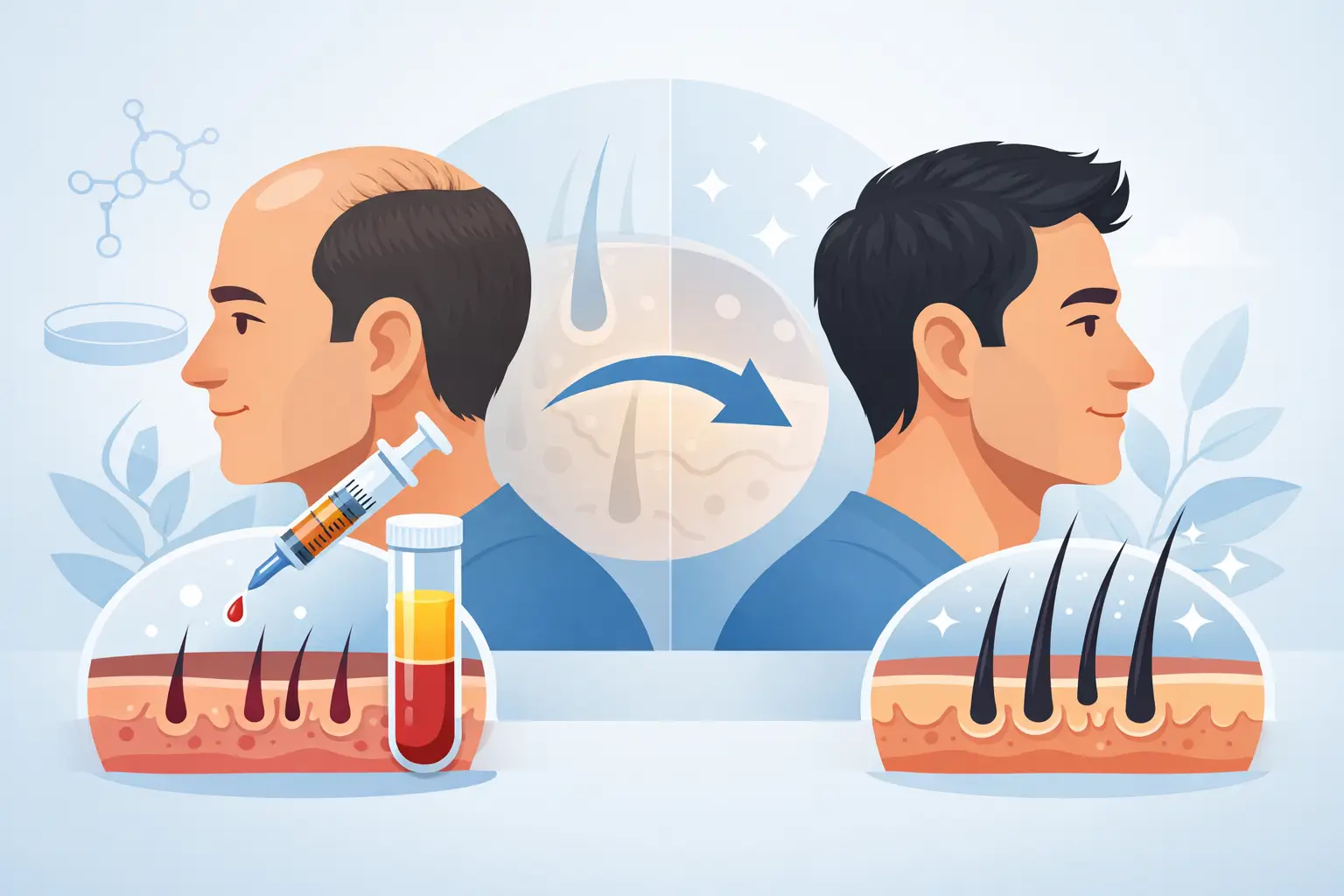
A widening part, more hair on the pillow, or a hairline that no longer frames your face the way it once did can affect far more than your appearance. It can change how confident you feel in photographs, at work, and in everyday social situations. So, can PRP treat alopecia? For the right type of hair loss and the right candidate, platelet-rich plasma treatment may help support stronger, fuller-looking hair growth. It is not a guaranteed cure for every form of alopecia, but it can be a valuable non-surgical option when treatment begins early and is planned properly.
Can PRP Treat Alopecia?
PRP stands for platelet-rich plasma. The treatment uses a small sample of your own blood, which is processed to separate and concentrate platelets and growth factors. This platelet-rich plasma is then carefully injected into areas of thinning hair on the scalp.
The aim is to stimulate weakened hair follicles and improve the environment around them. In suitable patients, this can encourage follicles to remain in the active growth phase for longer, improve hair shaft thickness, and reduce the appearance of diffuse thinning.
PRP is most commonly considered for androgenetic alopecia, also called male-pattern or female-pattern hair loss. This hereditary form of hair loss usually develops gradually. Men may notice receding temples or thinning at the crown, while women often see a broader part or reduced density through the top of the scalp.
When follicles are still present but producing finer, weaker hairs, PRP may be especially useful. If an area has been completely bald for a long time, the follicles may no longer be viable. In that situation, PRP alone is unlikely to create meaningful new coverage, and a hair transplant consultation may be the more effective route.
Which Types of Alopecia May Respond to PRP?
Alopecia is a broad term for hair loss, not one single condition. The cause matters because the best treatment depends on what is happening beneath the surface of the scalp.
Pattern Hair Loss
This is the strongest area for PRP treatment. Pattern hair loss is driven by genetics and hormones, gradually shrinking hair follicles over time. PRP can be used to support existing follicles before thinning becomes advanced. Many patients choose it because it is non-surgical, uses their own plasma, and can fit around busy work and social schedules.
Results vary, but patients may notice less shedding first, followed by improved texture, thickness, and density over several months. PRP does not change your genetics, so maintenance treatments are usually needed to protect the progress achieved.
Alopecia Areata
Alopecia areata is an autoimmune condition that often causes sudden, round patches of hair loss. PRP has been studied as a possible supportive treatment in some cases, but the evidence is less established than it is for pattern hair loss. A medical assessment is essential because treatment may involve other approaches depending on the severity and activity of the condition.
If hair loss appears suddenly in patches, do not assume it is ordinary thinning. Getting a proper diagnosis can save time and help you choose a treatment plan that actually matches the cause.
Scarring Alopecia and Advanced Hair Loss
Scarring forms of alopecia damage and replace hair follicles with scar tissue. PRP cannot restore follicles that have been destroyed. Similarly, very advanced baldness may have too few active follicles remaining for PRP to make a visible difference.
That does not mean your options are exhausted. A personalized consultation can establish whether you would benefit from PRP, medical hair loss management, or a hair transplant designed to restore a more defined hairline and better coverage.
What Does PRP Hair Treatment Involve?
A PRP appointment is straightforward. A clinician takes a small blood sample, similar to a routine blood draw. The blood is placed in a centrifuge, which separates the platelet-rich plasma from other components. The concentrated plasma is then injected across the areas of concern using fine needles.
Most appointments are completed within an hour. You may experience temporary tenderness, mild swelling, or pinpoint redness on the scalp, but there is generally little downtime. Many people return to normal daily activities shortly afterward, although your clinician may advise avoiding heavy exercise, alcohol, heat exposure, or washing your hair for a short period.
For best results, PRP is usually delivered as an initial course rather than a one-time appointment. A common plan involves several sessions spaced a few weeks apart, followed by maintenance sessions as recommended for your hair loss pattern and response to treatment.
When Will You See Results?
PRP is not an instant cosmetic fix. Hair grows slowly, and follicles need time to respond. Some patients notice reduced shedding within the first few months. Changes in thickness and overall coverage often take three to six months to become more noticeable, with continued improvement possible after that.
The most realistic goal is healthier-looking, denser hair where follicles are still active. Results can be subtle at first, especially if you see yourself every day. Clinical photography before treatment and at follow-up appointments can help you track changes objectively.
Your outcome may depend on your age, the underlying cause of alopecia, how long thinning has been present, the extent of hair loss, general health, and whether you follow a consistent treatment schedule. Earlier treatment usually gives PRP more to work with.
PRP vs. Hair Transplant: Which Is Right for You?
PRP and hair transplantation are not necessarily competing treatments. They address different stages and patterns of hair loss.
PRP may suit you if you have early or moderate thinning, want to preserve existing hair, and prefer a non-surgical treatment. It can also be considered alongside a broader hair restoration plan for patients who want to improve the quality of their native hair.
A hair transplant may be more appropriate if you have a stable pattern of significant loss, a visibly receding hairline, or bald areas where growth has stopped. A transplant redistributes healthy follicles from a donor area to thinning or bald regions, creating new, permanent-growing hair in those areas. It requires more planning and recovery than PRP, but it can offer a more dramatic improvement where PRP has limited potential.
At Essex Boys Medical Group, a consultation focuses on the result you want to see, the condition of your existing hair, and the treatment route that makes sense for your goals. There is no value in promising a full head of hair from PRP when a different solution would serve you better.
Is PRP Safe for Hair Loss?
Because PRP is made from your own blood, the risk of allergic reaction is low. As with any injectable treatment, possible side effects include short-term soreness, bruising, swelling, headache, or scalp sensitivity. Infection is uncommon when treatment is carried out in an appropriate clinical setting using proper sterile technique.
PRP may not be suitable for everyone. People with certain blood disorders, active infections, some medical conditions, or those taking specific medications may need alternative treatment or medical clearance first. An honest consultation about your health history is part of protecting your safety and your results.
How to Get the Best From PRP for Alopecia
PRP works best as part of a realistic, consistent approach to hair restoration. Avoid choosing treatment based on price alone or expecting one session to reverse years of hair loss. The quality of assessment, the treatment protocol, and the experience of the medical provider all matter.
It also helps to address factors that can worsen shedding, such as nutritional deficiencies, major stress, untreated scalp conditions, or sudden weight changes. If your hair loss is new, rapid, patchy, or accompanied by itching, pain, or scaling, seek medical evaluation before proceeding with cosmetic treatment.
Hair loss can feel personal, but it does not have to be something you simply accept without exploring your options. A focused consultation can clarify whether PRP is likely to support the hair you still have and help you take the next step toward looking in the mirror with greater confidence.
0 Comments