
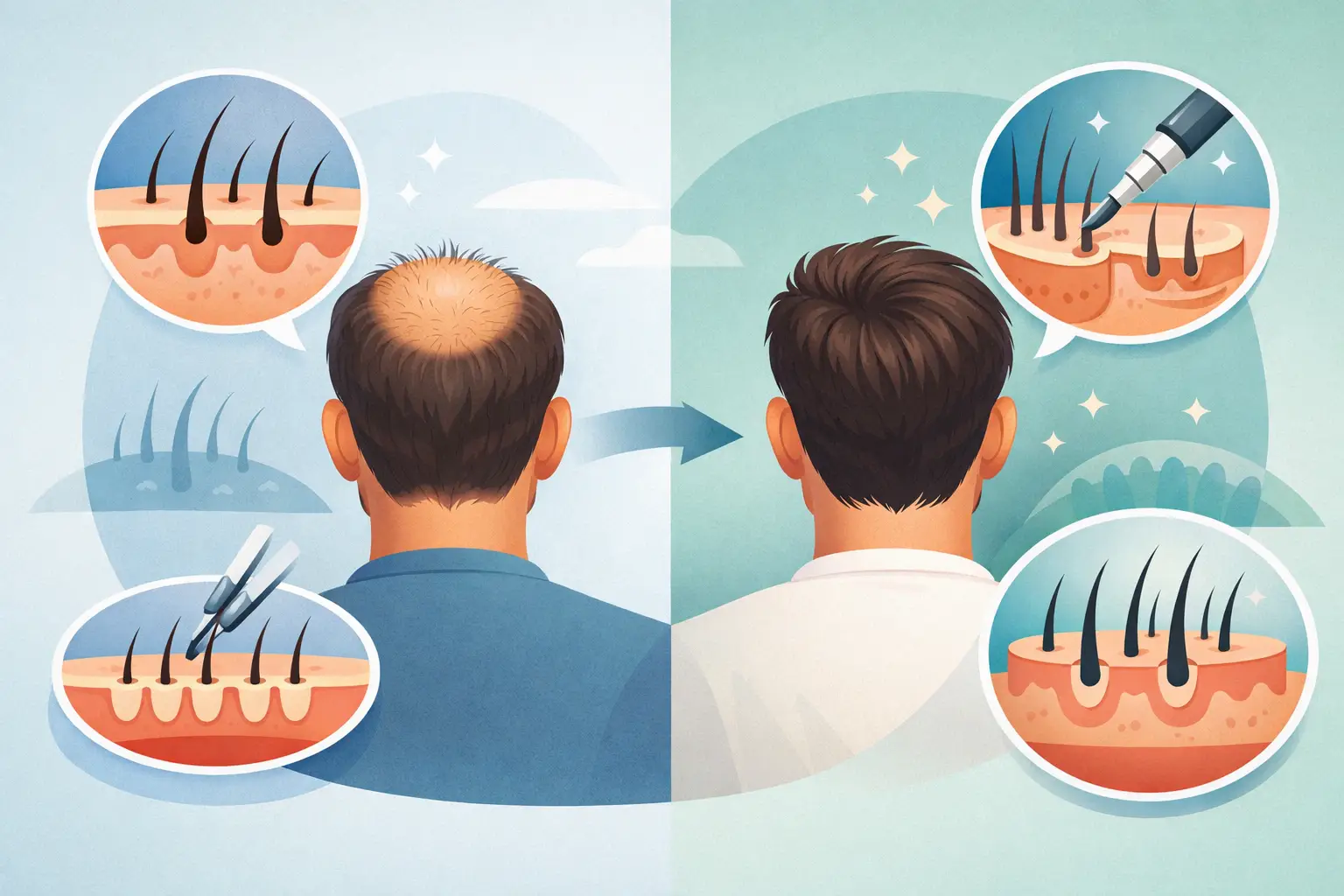
Hair transplant surgery is intended to provide a long-term approach to certain types of hair loss, but whether the result can be considered permanent depends on several factors. These include the pattern and progression of hair loss, donor hair characteristics, surgical planning and individual response to treatment.
Transplanted follicles are generally selected from areas of the scalp that are more resistant to pattern hair loss. However, non-transplanted hair may continue to thin over time, which is why long-term planning and an individual assessment are important.
A hair transplant can deliver long-lasting, natural-looking improvement that stays with you for years. For many patients, it is the closest thing to a permanent answer. But it is not magic, and it does not freeze the rest of your hair in time. If you want results that still look strong and balanced years from now, the quality of the medical plan matters just as much as the procedure itself.
Is hair transplant a permanent solution for everyone?
Not in exactly the same way for every patient. A transplant works by moving healthy hair follicles from a donor area, usually the back and sides of the scalp, into areas affected by thinning or baldness. These donor follicles are typically more resistant to the hormone-related hair loss seen in male and female pattern baldness.
That resistance is the reason hair transplantation is considered permanent in many cases. Once those grafts heal and begin growing in their new location, they usually continue to grow like they did in the donor area. You can cut them, style them, and treat them like your natural hair because they are your natural hair.
The part people sometimes miss is that transplanted hair and non-transplanted hair behave differently. Your new grafts may stay, while nearby native hairs can continue to thin over time. If the procedure is not planned properly, that can leave an uneven result later on. A good transplant is not just about filling a gap today. It is about creating a look that still makes sense as you age.
What “permanent” really means in hair restoration
When clinics describe a hair transplant as permanent, they generally mean the transplanted follicles are intended to keep growing for the long term. That does not mean every single graft survives, and it does not mean your scalp will never change again.
Some grafts may not take, especially if aftercare is poor or if healing is interrupted. More commonly, the transplanted hair grows well, but the original hair around it continues to miniaturize. This is why realistic planning matters. You are not buying a full reset to your teenage hairline. You are investing in a strategic improvement that should look attractive, natural, and sustainable.
That distinction is important for patients who want visible change without disappointment. If your expectations are based on what the procedure can genuinely achieve, a transplant can be one of the most rewarding appearance treatments available.
Why transplanted hair tends to last
The science behind it is straightforward. Hair taken from the back and sides of the scalp is often genetically programmed to resist the shrinking effect of DHT, the hormone linked to pattern hair loss. When those follicles are moved to the front, temples, or crown, they usually keep that same resistance.
This is known as donor dominance. In practical terms, it means the transplanted follicles keep behaving like donor hair even after relocation. That is why so many patients continue to grow transplanted hair for decades.
Still, “usually” matters. Longevity is strongest when the donor area is healthy, the extraction is done carefully, and the hairline design matches the patient’s age and future loss pattern. If any of those factors are handled badly, permanent potential can be wasted on a poor outcome.
What can affect your long-term result?
A lasting result depends on more than the surgery itself. Your age matters because younger patients may have more future hair loss ahead of them. Your family history matters because it helps predict how aggressive that loss may become. Your donor density matters because it determines how much strong hair is available for transplantation.
Technique also matters. Overharvesting the donor area can thin out the back of the scalp. Placing grafts at the wrong angle can make the result look artificial. Creating a low, aggressive hairline on someone likely to lose more hair later can cause problems down the line.
Aftercare is another major factor. The first few weeks are crucial for healing, graft survival, and avoiding trauma to the scalp. Smoking, poor scalp care, ignoring washing instructions, or returning to intense activity too early can all affect the result.
Then there is ongoing hair loss. A transplant does not stop the progression of pattern baldness in untreated areas. That is why some patients benefit from combining surgery with a broader hair restoration plan.
The role of PRP and maintenance treatments
If you still have thinning native hair, supportive treatments can help protect what remains. PRP is often used as part of a broader hair restoration strategy to improve scalp condition and support weakened follicles. It does not replace a transplant when hair is already gone, but it can complement surgical results by helping maintain surrounding hair.
For the right patient, that combination can create a fuller-looking outcome for longer. It is often not about choosing one treatment or the other. It is about building the right plan for your stage of hair loss.
Is one hair transplant enough?
Sometimes yes, sometimes no. Many patients achieve a satisfying transformation with one well-executed procedure, especially if their hair loss is stable and the treatment area is clearly defined. Others may need a second session later, either to add density, address the crown, or keep pace with continued loss in untreated areas.
This is not necessarily a sign that the first procedure failed. It may simply reflect the reality of long-term hair loss. A smart treatment plan takes that into account from the beginning.
Patients often do best when they think in terms of a long-term aesthetic strategy rather than a one-time fix. The goal is not only to restore hair. It is to protect your appearance, confidence, and natural balance over time.
Who gets the best permanent results?
The strongest candidates usually have stable pattern hair loss, good donor hair, realistic expectations, and a clear understanding of what they want to improve. Men with a receding hairline or thinning crown often do very well, but women with suitable donor areas can also benefit significantly.
Patients who are very young, rapidly losing hair, or expecting extreme density from limited donor supply may need a more careful approach. In those cases, the right clinic will not simply say yes to a procedure. It will guide you toward the option that gives you the best long-term appearance.
That kind of honesty matters. A natural-looking result that ages well is far more valuable than a quick cosmetic fix that creates future problems.
How long does it take to see the final result?
Patience is part of the process. After the transplant, the newly placed hairs often shed before growing back. This is normal. Early growth may begin around three to four months, with visible improvement building steadily after that.
Most patients see a strong cosmetic difference by around eight to twelve months, although crown results can take longer. The final texture and maturity of the hair may continue improving beyond that point. If you expect instant fullness, the timeline can feel slow. If you understand the process, it becomes much easier to judge the success of the treatment properly.
The real answer to “is hair transplant a permanent solution”
Yes, in many cases a hair transplant is a permanent solution for the hairs that are successfully transplanted. Those follicles are typically chosen because they are resistant to the pattern of loss affecting other parts of the scalp, and they can continue growing for many years.
But the best answer is more honest than a simple yes. A transplant is permanent in principle, yet your broader hair story can still change. Native hair may continue to thin. Some patients may want future treatment. And the quality of your result depends heavily on planning, technique, and maintenance.
That is why the most successful patients do not just ask whether the procedure lasts. They ask whether it will still look good in five or ten years. That is the right question.
At Essex Boys Medical Group, the focus is not just on adding hair. It is on helping patients look stronger, fresher, and more confident with results that suit their face, age, and goals. If you are considering treatment, the smartest next step is a proper consultation with an experienced team that can assess your hair loss honestly and build a plan around your future, not just your current photos.
The best hair restoration result is one that still feels like you – just more confident every time you look in the mirror.
0 Comments